Hello all,
Maybe some of you have seen this Call for New Aesthetics coming from Patrick Collison and Tyler Cowen. The debate is couched in a kind of lingering sensation among the powers that be in Silicon Valley that we need a new culture to step into the future. You can see this in some of PC’s recent tweets about the return of Catholicism in Silicon Valley, etc, but this time around it’s architecture and design.
Perhaps from my sparse contributions to this forum, you may expect that I’m skeptical of this. The idea that one can “pitch an aesthetic”, rather than it developing from a particular historical context is, at best, awkward. Nonetheless, it got be reflecting on what modernism was, and what elements of it I’d like to rescue.
In particular, I isolate a principle of “invisibility”. I wrote out an essay on the topic which I reckon might be interesting to this community. Being a programmer, it has a bunch of hidden intuitions from our fields, despite them never being named as such. It follows:
What was modernism?
A preliminary response to the A Call for New Aesthetics.
To dwell then meant to inhabit one’s own traces, to let daily life write the webs and knots of one’s biography into the landscape.
Ivan Illich, Dwelling, An Address to the Royal Institute of British Architects, 1984.
Modernism was a response to a specific historical moment: rapid industrialization in the late 19th and early 20th centuries triggered a large movement of population towards cities. Living conditions in early modern cities were truly despicable and the modernist movement in design and architecture aimed to solve this concrete challenge. The centrality of basic hygiene in this project, something taken for granted today, is best noted in Adolf Loos’ paean to sanitation, The Plumbers, from 1898. The desire to marry industry and craft to meet this challenge led to the creation of institutions such as the Deutscher Werkbund, led by Mies van der Rohe, which further hoped to allow a newly-formed Germany to compete industrially. The situation exacerbated with the carnage of WWI, spurring on the creation of the Bauhaus by Walter Gropius, inspired by the radicality of the Russian constructivists and their ambition of reshaping life through art. The approach was to redirect the energy of industry towards the very act of living.
Specifically, the essence of the modernist ethos was that newly developing industrial processes could offer bare-bone infrastructure for the masses. The aesthetic of this infrastructure would be a direct translation of the machine into architectural form. The job of the modernist architect was not to provide decoration for the city, nor to pay tribute to the hegemonic powers by materializing power in the form of monuments. The job of the modernist architect was technical, it was to offer infrastructure: housing with excellent lighting, ventilation, and plumbing, public spaces for leisure, and domestic furniture and utensils that solve basic material needs. Critically, this basis of material needs would be a scaffold on top of which humans could progressively layer their own personalities, as the rituals and peculiarities of ordinary life accreted onto their homes. It was not the goal of the modernist architect to dominate the built environment with their designs. The modernist architect, if successful, is invisible.
Casa de Vidro, Lina Bo Bardi
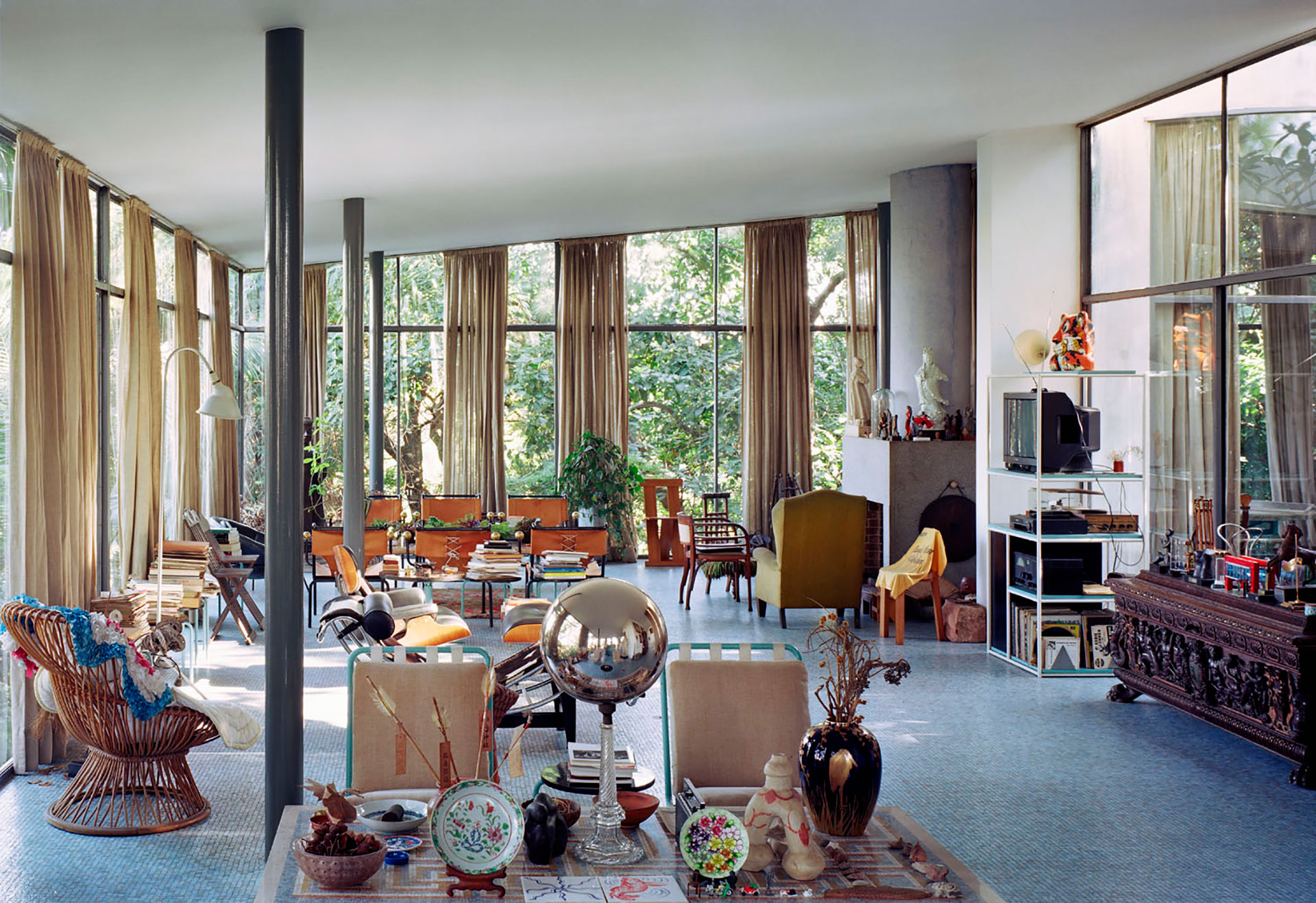
The layering of invisible infrastructure and personal decor can best be understood, in the domestic realm, by looking at the homes that the modernist architects designed for themselves: the Eames’ Study House No. 8, Lina Bo Bardi’s glass house, Isamu Noguchi’s Queens studio, or Luis Barragán’s home in CDMX. In every case, an industrial, modular, lightweight base is then filled with ornament and decoration, often splendid collections of vernacular art, or in Barragán’s case, baroque catholic iconography. The modernist ethos does not disown ornament, but rather understands ornament to be a consequence of a beautifully lived life, accretions of objects of sentimental value, rather than purchased artifacts laden in status. This could be an inherited grandfather clock, a personal library of books amassed over decades, the drawings of one’s children, or a hobbyist’s lepidoptera collection. However, it is critical to note that this ambition was supposed to go beyond these bourgeois homes that often serve as poster cards for modernist design.
Quinta Monroy, Aravena/ELEMENTAL
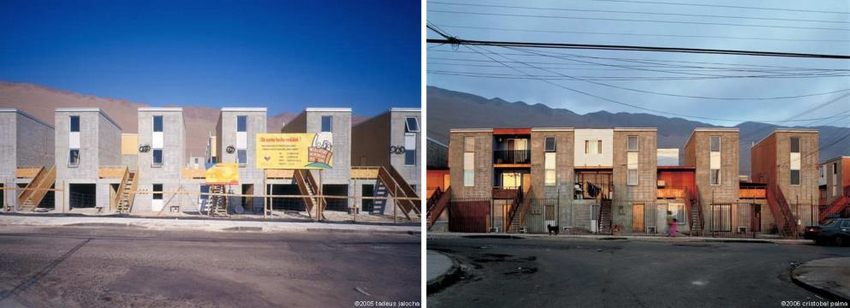
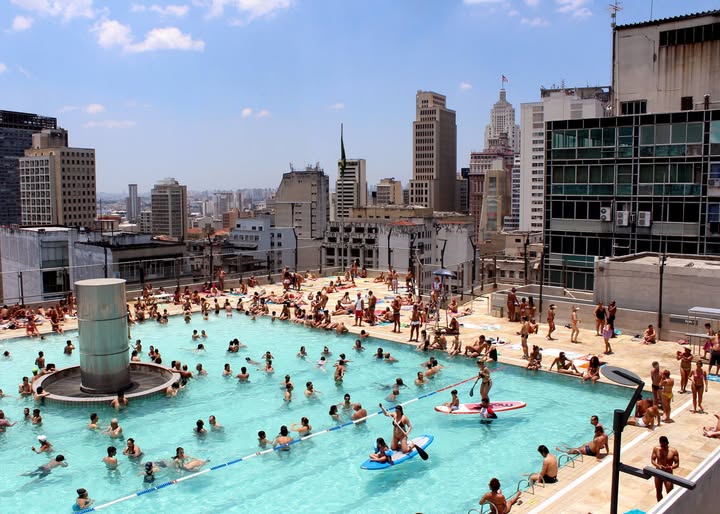
Two contemporary examples which go beyond the realm of luxury are Alejandro Aravena’s Quinta Monroy pre-fab housing and SANAA’s Gifu Kitagata apartment complex, both designed such that residents can fill in their home with their own lives, the former more literally, by expanding the home’s structure to accommodate a workshop, or a storefront, or an extra room for one’s aging grandparents, the latter visually, by highlighting personal storage on the very façade of the building, gaining color and complexity as more and more residents make it their own. At the urban scale, a similar insight can be seen in the Pacaembú pool complex in São Paulo, where a sand-colored concrete grandstand surrounds an Olympic swimming pool, mirroring the beaches of Rio de Janeiro, or in the SESC 24 de Maio pool, nestled along the skyline. There are no decorations other than the very people themselves, punctuating the concrete with their tanned bodies, colorful bikinis and sungas, cangas waving in the air as they’re laid on the ground for an afternoon of loitering.
SESC 24 de Maio, Paulo Mendes da Rocha
On top of this basic principle of invisibility, without compromising the commitment to mass scale, further aesthetic concerns are layered in. A central claim of the Bauhaus was that, while the production of ornament has cost, structural components of architecture such as color and proportion are free. Hence the predominance of basic coursework on color theory, materials, and geometric composition in the Bauhaus. The pursuit then was for economical structures that could be produced en masse, based on these general principles of color and geometry. A contemporary twist on this “for free” apporach can be seen in Christophe Lemaire’s dedication to color for the Uniqlo U line of clothing, the cost of an ugly dye being the same as a beautiful one, or in Trader Joe’s elaborate names for their products, noting in jest that “adjectives are free.” This highlights not a rejection of ornament per se, but an emphasis on the economy of form.
Casa-Estudio Luis Barragán
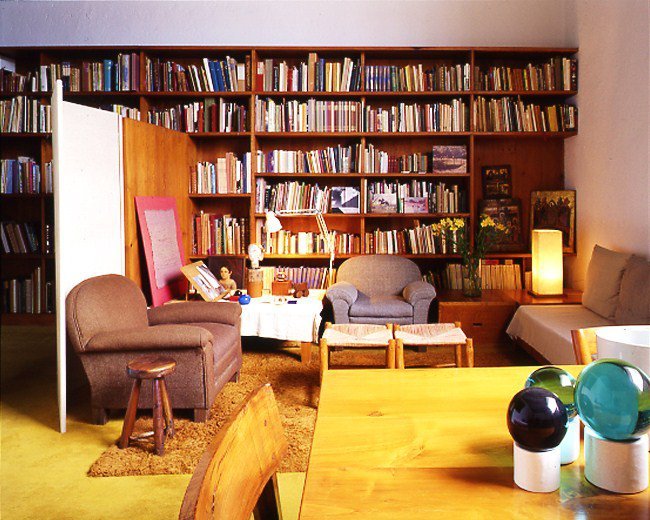
Contemporary critiques often center on the failure of British brutalism, the empty streets of Brasilia’s superquadras, the disjointedness of deconstructivist architecture, or the sterility of contemporary starchitecture, often confusing the radically different contexts of the four (post-war reconstruction, state-led national identity formation, digital techniques in architectural drawing, and late-capitalist luxury goods), lumping them under a shared moniker: modernism. All four are said to stem from the same fundamental error, a rejection of beauty for economy, and are followed by a plea for a return to the ornamentation of religious monuments such as Chartres, La Sagrada Familia, or the Alhambra. The goal here is not to defend any specific buildings, nor to condemn ornamentation and grandiosity, though beware of any commentator who condemns Le Corbusier’s “machine for living,” but fails to mention Ronchamp. The sleight of hand is that these buildings are of a fundamentally different nature to family housing, akin to comparing a Alfa Romeo Disco Volante to a Fiat Panda. The ethos of modernism was, once again, popular and at scale, and so the critique must be centered on why that aspect of the project failed, as it most certainly did.
The demolition of Pruitt-Igoe
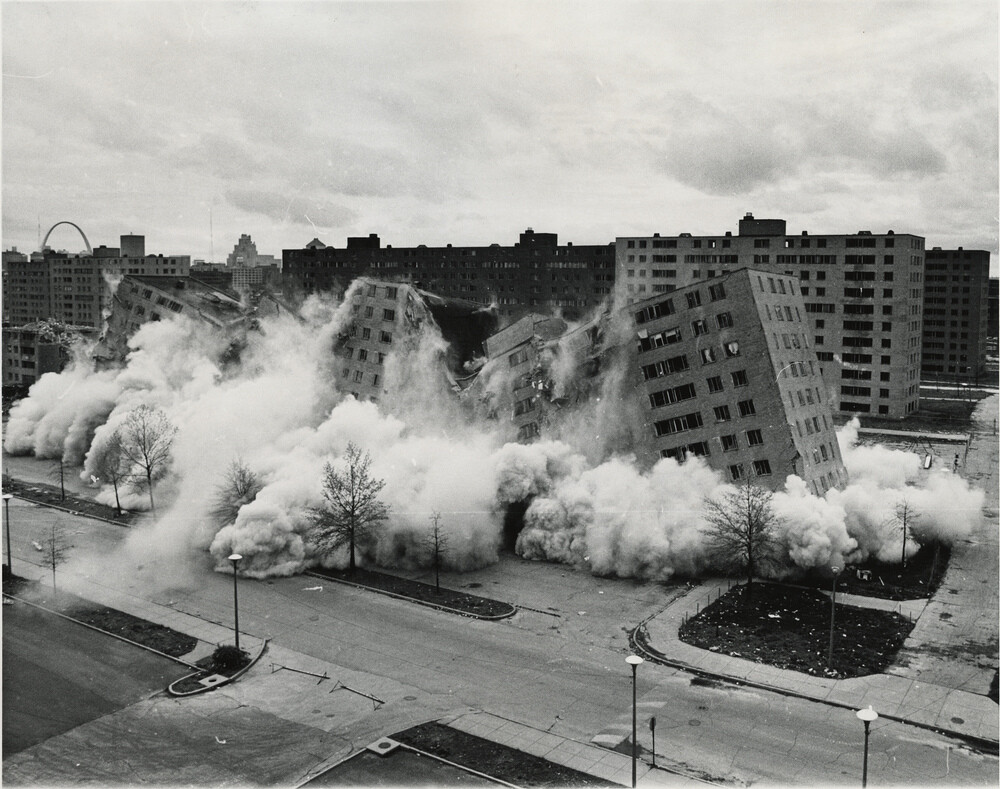
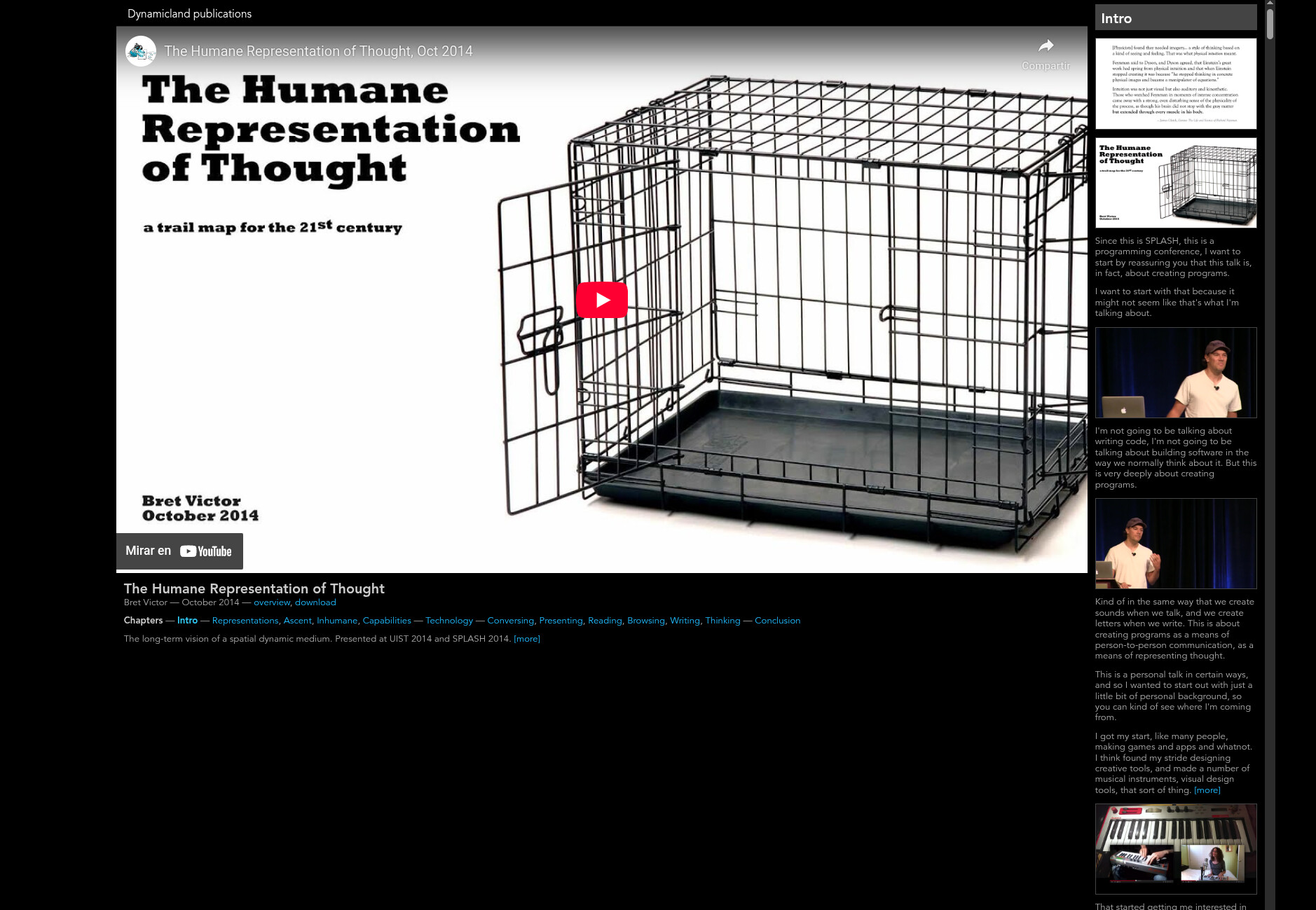
The mistake of the modernism was not aesthetic, nor was it in its functional and hence expressively mute style, but rather in not understanding the social labor that goes into filling a home. Leisure time is needed for a modernist home to be filled with a life, and indeed rarely is there criticism of the bourgeois modernist homes that ubiquitously decorate Pinterest and Are.na boards. Leisure time is needed to loiter at a public swimming pool, which is why the Pacaémbu complex is mostly used by the wealthy residents of the Higienópolis neighborhood, rather than the working classes. The revolution in building succeeded. The issue was that it did not accompany a utopia of labor conditions. And indeed, when a modernist house is laid bare, as is the case when we look at classic examples of failed public housing such as Pruitt-Igoe, when it is occupied only during the measly hours of sleep between working shifts, or when legal terms on a rental means that it cannot be modified by those who live within it while a rentier class continues to consider housing a speculative asset, it looks like a dog cage for an imprisoned soul.
Seeing those imprisoned souls, we wonder if our architecture ought not to inspire beautiful living. We ask if our swimming pools ought not to have beautiful murals like the Foro Italiano. We look nostalgically at other societies, where labor is integrated to ordinary life, where there isn’t a working class, but rather humans living in subsistence, and hence folding their lives into the built-environment in their own vernaculars. These are indeed two directions to go, proto-fascism or back-to-the-land collectivism, both bringing their own (very successful) aesthetics and (not so successful) politics along with them. However, this lamentation inverts the causality, asking life from a building when what we ought to allow for is the vitality of a human.
There are lessons to learn, but we must not ignore the foundational civic questions that drove the modernist: How to design for someone unlike oneself? How to design infrastructure that others can depend on without submitting them to the prejudices of the designer? How to build a shared sense of place and responsibility in the city, the home for deracinated travelers, of immigrants of different histories and backgrounds? We can still keep the mass, popular ethos of modernism alive. That does not mean blindly defending modernist buildings because of their ideological purity, nor because of their value as status symbols, debasing the invisibility that was at their conception. Rather, it means attacking the root of the problem, the reason why these technical scaffoldings are not teeming with life: income and leisure.
Cristóbal Sciutto Rodríguez
December, 2025
Thanks to Machine Wash Cold for feedback.