Software, protocol, and associated workflows developed by Ward Cunningham and collaborators since 2011
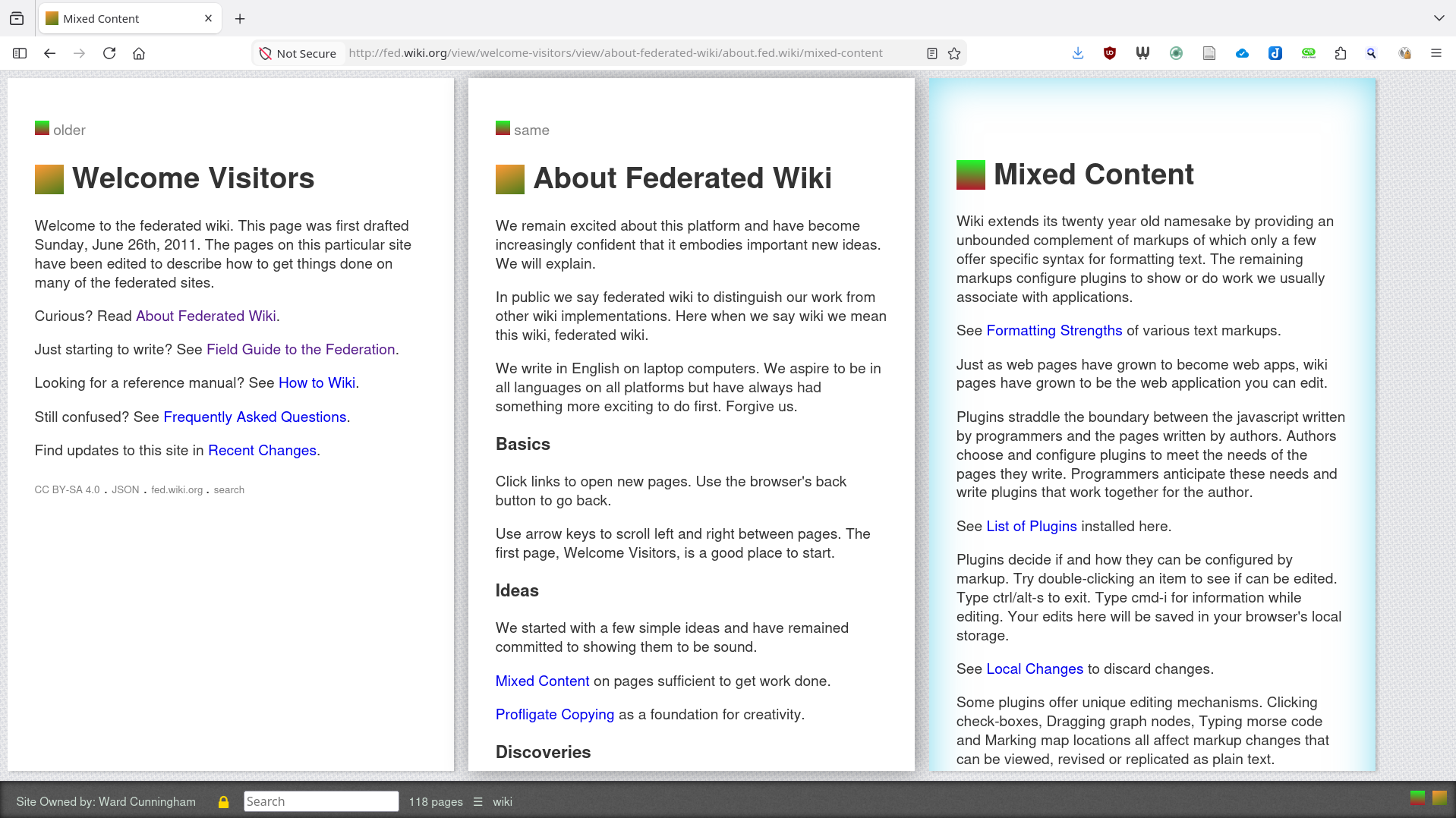
A traditional wiki contains a single concensus version of each page. In Federated Wiki, participants maintain their own personal versions of each page, but follow the work of their peers and borrow material from them to make it their own. Another important evolution from traditional wikis is that pages can contain not only text and images, but also data and tools, which are implemented as plugins to the Federated Wiki software.
I tried to evaluate Federated Wiki relative to the seven criteria on our Web site.
Software must be as easy to change as it is to use it
This criterion penalizes software that is very easy to use! The most basic use of Federated Wiki as a personal public notebook requires little more than typing text. In comparison, anything code-related is a lot more difficult.
All layers, from the user interface through functionality to the data within, must support arbitrary recombination and reuse in new environments
This criterion applies only to software. Federated Wiki is also a protocol with multiple implementations that differ significantly. The Federated Wiki software most used today is simple, almost minimalist, and framework-free JavaScript. Reuse should not be difficult (but I am not competent enough at JS to be worth listening to).
Tools should strive to be easy to begin working with but still have lots of open-ended potential
Federated Wiki scores very high on this one.
People of all experience levels must be able to retain ownership and control
High score as well.
Recombined workflows and experiences must be freely sharable with others
One more. It’s a lot more difficult not to share one’s work, as everything is public unless you build a VPN around your Wiki nodes.
Modifying a system should happen in the context of use, rather than through some separate development toolchain and skill set
True only for the third (and most recent, so far little used) code layer, the one that lives inside Wiki pages (see here).
Computing should be a thoughtfully crafted, fun, and empowering experience
A rather subjective judgement, but I’d say Federated Wiki does pretty well.
Trust but even more importantly reciprocal engagement. Many of the problems of message-based social networks (in particular moderation) disappear when there are no messages. There is almost no attack surface for rogue actors.
Many of today’s social media are ambiguous about the context they try to address. For Twitter/X and BlueSky, that’s pretty clear: they want to be the global town square, where all conversations happen in the open. But attention to messages doesn’t scale from a town square to global, which is what allows rogue behavior to pass undetected.
Mastodon wants to be for some “community”, but its federation model doesn’t correspond to communication between communities, and most users see it as a distributed version of the town square, whatever that could mean. I have been told (by participants) that small, focused, closed Mastodon instances for a well-defined community actually work well in practice. So the issue is federation.
Federated Wiki doesn’t have that issue. It’s for teams that collaborate in the open. That’s small groups, who also have other communication channels. Much like people collaborating via a software forge, but for different media and with different affordances. Federation is not the same as in the Fediverse.